
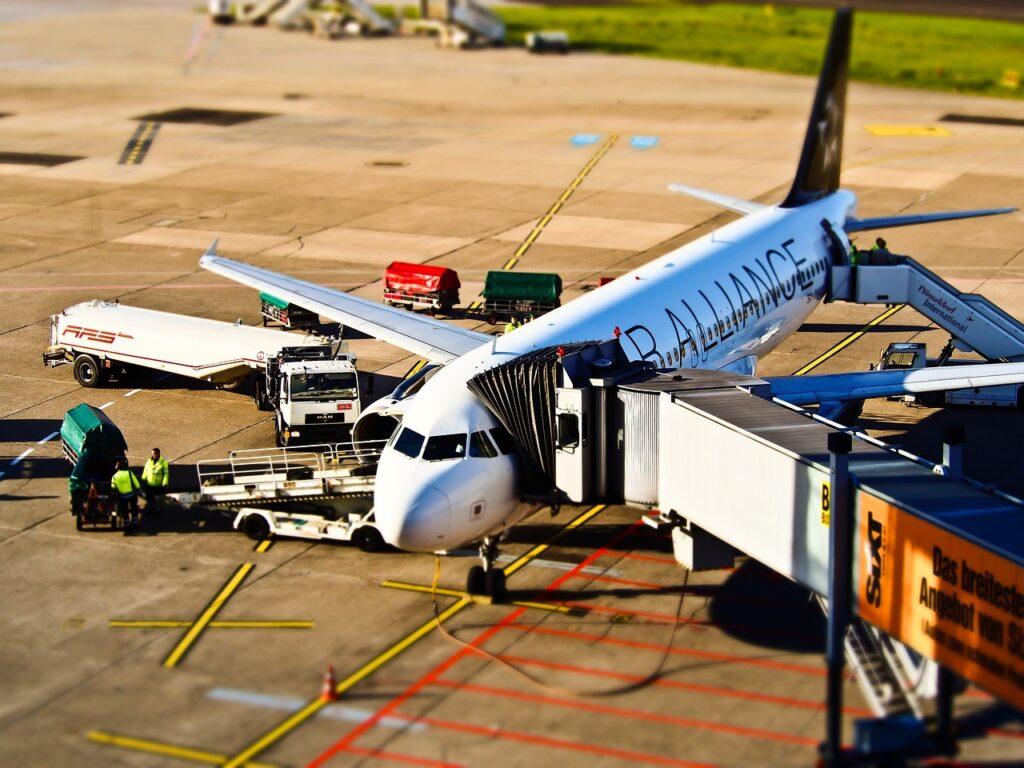
I was sitting in a
plane taxiing out to the runway at T1 in Sydney last week and it struck me, not
for the first time, just how much infrastructure we have surrounding air
travel. When the Wright brothers flew the Wright Flyer at Kitty Hawk in 1903, I
am certain they could not possibly have envisaged just how much infrastructure
we would build around the world to support air travel.
There are 4,159
airports with scheduled passenger flights, plus tens of thousands of private,
recreational and military airfields. But the number alone doesn’t tell the
story. Think about what surrounds every airport with commercial flights.
Runways, taxiways,
aprons, terminals, baggage systems, refuelling facilities, control towers,
navigation equipment, fire services, maintenance hangars and enough security to
ensure you can never accidentally take a pair of nail scissors onto an
aircraft.
And when aircraft
change, airports have to change with them.
When the enormous
Airbus A380 was being developed, its sheer size presented airports with a new
challenge. In March 1999, the International Civil Aviation Organisation
introduced Code F, a new aerodrome reference category designed to accommodate
aircraft of its scale. For airports wanting to welcome the A380, that meant
substantial changes to existing infrastructure.
Now aviation may be
approaching another infrastructure moment.
The largest
battery-electric aircraft ever flown took to the skies for the first time in
the middle of August. The Heart Aerospace X1 demonstrator flew for 27 minutes up
to an altitude of 1,100 feet.
That flight is
important not because you will be booking a seat on an X1 this Christmas. You
won’t. It is a demonstrator designed to prove that electric propulsion can work
at the scale of a commercial airliner.
The production
aircraft it is helping develop is designed to carry 30 passengers, with a
target all-electric range of several hundred kilometres. Forget Sydney to
London. Think major cities to regional centres.
And that may be where
electric aviation becomes genuinely interesting for Australia.
Battery-powered
aircraft face one enormous problem: batteries are heavy. Jet fuel contains
vastly more usable energy for its weight and, conveniently, an aircraft gets
lighter as it burns fuel. A battery weighs the same whether charged or
discharged.
Adding more batteries
to increase range therefore adds more weight, which requires more energy, which
requires more batteries, which requires more… you get the picture.
That means their
natural home will be short regional routes.
Australia’s Aviation
Green Paper has suggested current battery technology is most suited to routes
of roughly 300 to 500 kilometres, with longer one-to-two-hour electric flights
potentially becoming possible as battery energy density improves.
But changing the
aircraft is only half the story.
Just as the A380
forced airports to rethink gates and taxiways, electric aircraft will force
airports to rethink energy. Instead of aviation fuel arriving in tankers,
airports may need megawatt-scale electrical connections, battery storage,
renewable generation and high-powered aircraft chargers capable of turning
planes around quickly through fast charging or possibly even battery-swapping. Land
surrounding an airport could be used to generate solar energy, allowing the
power to be used directly where it is generated.
Electric aircraft
should also be quieter and mechanically simpler, with electric motors
containing far fewer moving parts than turbine engines. That could mean lower
maintenance costs and potentially make routes viable that airlines currently
consider uneconomic.
The electric aircraft
revolution won’t begin with a long-haul international route. It will start
quietly, perhaps with 30 people flying a couple of hundred kilometres.
The Wright brothers
started with 12 seconds and 37 metres.
Sometimes the biggest
revolutions begin with something surprisingly small.
Mathew
Dickerson